Heritage & research
Collections and the people who study them
Archives, museums and libraries. Researchers and genealogists. Newspaper and media archives. Documents, photographs and film that need a record before they can be found.
A cataloging system for documents, photographs and films. It reads any language, including handwriting and non-Latin scripts, and drafts the metadata. A person approves the record. Built for any organization with a collection, not for one language or one kind of institution.
A page from a real government file of 1959–1962, typed in Hebrew. Beside it, the English catalog record the system drafted from the scan, with its translation. Green: what the system identified. Amber: a field completed in human review.
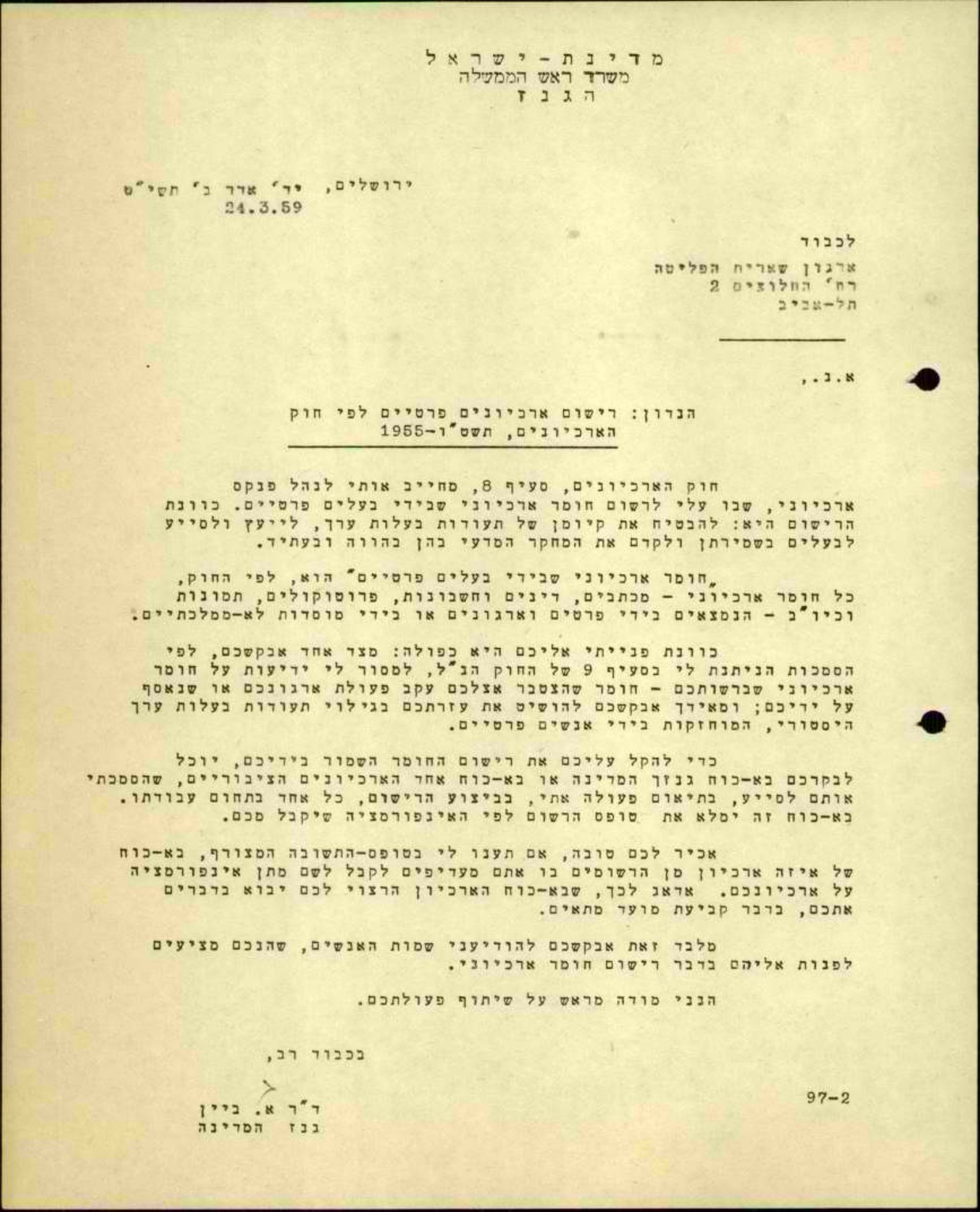
State of Israel
Prime Minister's Office
The Archivist

Jerusalem, 14 Adar II 5719
24.3.59

To
The She'erit Hapletah organization
2 Ha-Halutzim St.
Tel Aviv

Dear Sirs,

Subject: Registration of private archives under the Archives Law, 5715-1955

Section 8 of the Archives Law obliges me to keep an archival register, in which I am to record archival material held by private owners. The purpose of registration is to ensure the survival of valuable documents, to advise and assist owners in preserving them, and to promote scholarly research on them, now and in the future.

"Archival material held by private owners" is, under the Law, any archival material - letters, memoranda and accounts, minutes, photographs and the like - held by individuals and organizations or by non-state institutions.

My approach to you has a twofold purpose. On the one hand, under the authority granted me in Section 9 of the above Law, I ask you to provide me with information on archival material in your possession - material that accumulated with you as a result of your organization's activity or that was collected by you. On the other hand, I ask you to lend your help in locating documents of historical value held by private persons.

To ease the registration of the material in your hands, a representative of the State Archives or of one of the public archives, whom I have authorized to assist in coordination with me, each in his own field of work, may visit you. This representative will fill in the registration form according to the information he receives from you.

I would be grateful if you would reply, on the enclosed reply form, which of the archives registered there you prefer to send a representative to obtain information about your archive. I shall see to it that the representative of the archive you prefer contacts you to set a suitable date.

In addition, I ask you to inform me of the names of persons whom you propose that I approach regarding the registration of archival material.

I thank you in advance for your cooperation.

Yours sincerely,
[handwritten signature]
Dr. A. Bein
State Archivist

97-2
A real file. Details that identify where it is held, its reference number and the archive, are removed. The system drafted this record and the translation from the scan alone; one field was completed in review.
One scan, the text the system read from it, and the catalog record it drafted. Green: what the system identified. Amber: a field corrected in human review.
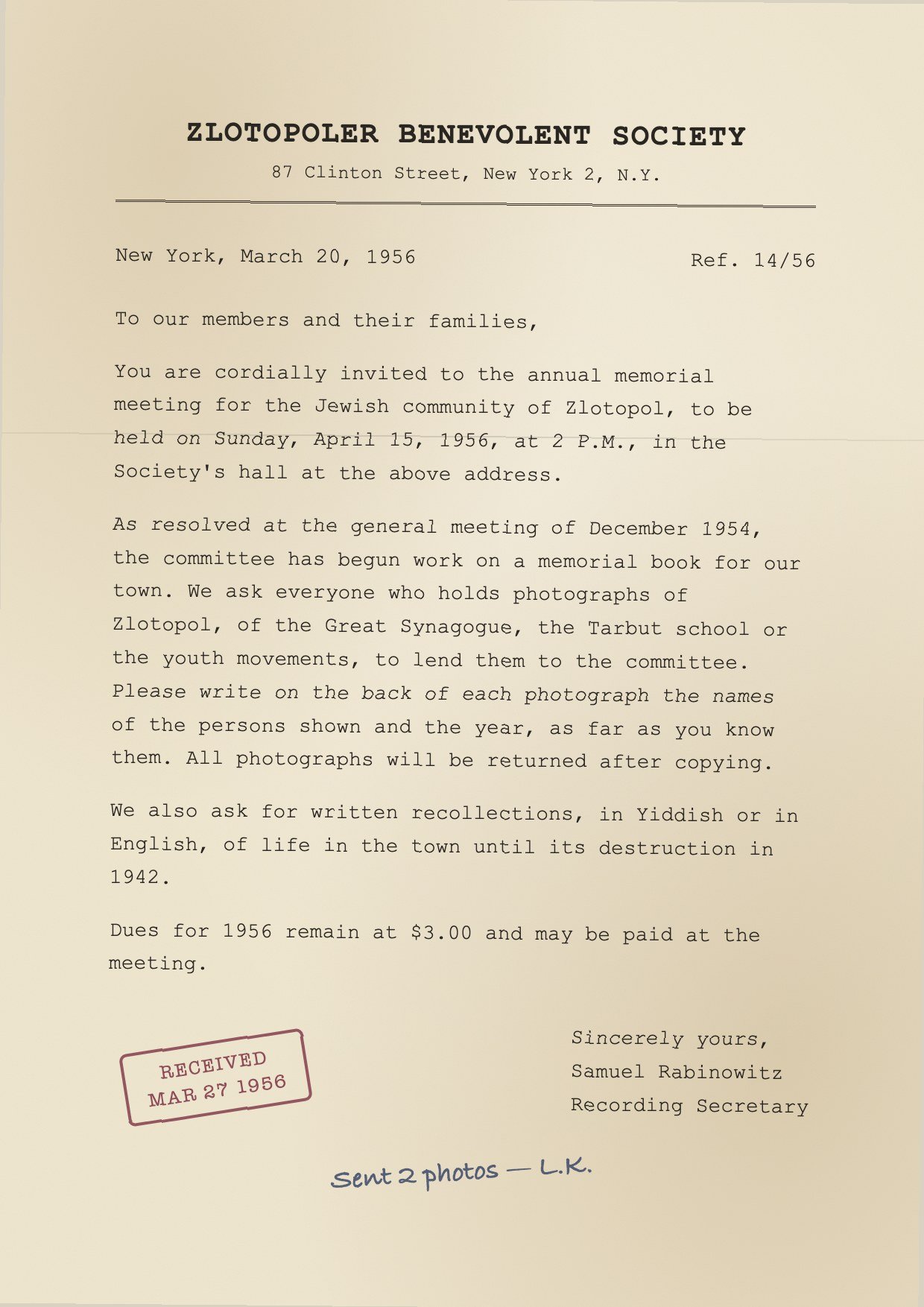
ZLOTOPOLER BENEVOLENT SOCIETY
87 Clinton Street, New York 2, N.Y.

New York, March 20, 1956                                        Ref. 14/56

To our members and their families,

You are cordially invited to the annual memorial
meeting for the Jewish community of Zlotopol, to be
held on Sunday, April 15, 1956, at 2 P.M., in the
Society's hall at the above address.

As resolved at the general meeting of December 1954,
the committee has begun work on a memorial book for our
town. We ask everyone who holds photographs of
Zlotopol, of the Great Synagogue, the Tarbut school or
the youth movements, to lend them to the committee.
Please write on the back of each photograph the names
of the persons shown and the year, as far as you know
them. All photographs will be returned after copying.

We also ask for written recollections, in Yiddish or in
English, of life in the town until its destruction in
1942.

Dues for 1956 remain at $3.00 and may be paid at the
meeting.

Sincerely yours,
Samuel Rabinowitz
Recording Secretary

[Stamp:] RECEIVED MAR 27 1956
[Handwritten:] sent 2 photos — L.K.
Illustrative example. Every field was produced by the system from the scan alone, with no prior information. One field, Places, was corrected in review: the system listed the two places in a way that read as if Zlotopol were in New York, so the reviewer separated them. The record was also exported to Dublin Core.
Any organization that holds documents, photographs or video. A historical collection is one case, not the only one.
Heritage & research
Archives, museums and libraries. Researchers and genealogists. Newspaper and media archives. Documents, photographs and film that need a record before they can be found.
Business & legal
Law firms, insurance companies and accounting firms. Film and television production companies. Case files, policies, ledgers and production material, in print or handwriting.
Health & public sector
Hospitals and medical-records departments. Municipalities and records departments. NGOs and schools. Sensitive documents stay confidential to the organization.
Upload scans of documents, photographs and films. A file, an album or a reel. Mixed languages are the normal case.
OCR in any language, including handwriting and non-Latin scripts, pulls out the text. AI metadata proposes a title, dates, places and names, with a confidence mark on each identification. What the source does not say stays blank.
Someone on your staff reviews the draft. Approved records are searchable. Export them to EAD, Dublin Core, MARC21, or the sheet you already use.
One catalog for files, images and moving image, including notes on the back of a photograph.
Print and handwriting. Latin and non-Latin scripts are read the same way. Hebrew, Arabic and Cyrillic are examples, not a limit. The catalog record is written in the languages the organization works in.
Title, dating, places and persons, as cataloging prose rather than a pile of keywords.
Each identification is marked confirmed, probable or tentative. If the source is silent, the field stays empty.
The system proposes. Only a person on your staff promotes a draft to a record. Delicate identifications stay a human decision.
EAD, Dublin Core, MARC21, and the sheet your organization already uses. It fills the catalog or records system you have. It does not replace it.
No shared tenancy. Your material is not used to train models. Sensitive documents stay confidential to your organization. For material that must stay on site, processing can stay local.
Fields, vocabularies and working languages come from the organization itself, not from a single thesaurus every client has to wear.
Two ways to try the system. Continued use after a pilot, or a collection larger than the free allotment, is arranged directly with us.
Organizations
A free pilot of 100 documents, 10 photographs and 5 films, with no time limit. For any organization with documents, photographs or video. Multilingual OCR is included. You can export the records at the end.
Request the organizational pilotIndividuals
Those 10 items stay free. For researchers, genealogists and anyone cataloging their own documents, photographs or films.
Start with 10 free itemsDocuments, photographs and films. A file, a photo album and a reel can sit in the same catalog. Notes written on the back of a photograph are read together with the image.
No. It catalogs documents, photographs and films for any organization that holds them. That includes archives, museums and libraries; researchers and genealogists; law firms, insurance companies and accounting firms; film and television production, and newspaper and media archives; hospitals and medical-records departments; municipalities and records departments; NGOs and schools. OCR and metadata work for any language, in print or handwriting, including non-Latin scripts. It is not limited to one subject, one sector or one language.
Any language. Print and handwriting are both in scope. Latin scripts and non-Latin scripts are read the same way. Hebrew, Arabic and Cyrillic are examples, not a limit. The catalog record is written in the languages the organization works in.
A draft record: a title, dates, places and names, written as cataloging prose, with a confidence mark on each identification — confirmed, probable or tentative. If the source does not say it, the field stays empty. A person reviews the draft before it becomes a record.
EAD, Dublin Core and MARC21, and the sheet your organization already uses. The system does not replace ArchivesSpace, AtoM, or the catalog or records system you have. It fills them.
Organizations can run a free pilot of 100 documents, 10 photographs and 5 films. There is no time limit on that pilot. Individuals can catalog 10 items free, and those 10 items stay free. Multilingual OCR is included. Records can be exported. Continued use after a pilot, or a collection larger than 10 items, is arranged directly with us.
Each organization has a dedicated server. Sensitive documents stay confidential to that organization. Your material is not used to train models. You can export your records, including at the end of a pilot. No security or privacy certification is claimed.
Tell us whether you are an organization or an individual, and what you want to catalog. Or write directly to [email protected].