We conduct reliable, in-depth historical research based on rigorous academic standards. We utilize
innovative technological tools to expand the boundaries of historical inquiry and develop new ways to
understand the past.
We apply our methodologies across wide range of sectors:
Insights from the intersection of history and artificial intelligence.
To transform technology into a vital asset for historical research: developing methodologies that enable deep, thorough, and efficient analysis of diverse historical sources, while upholding the highest professional standards.
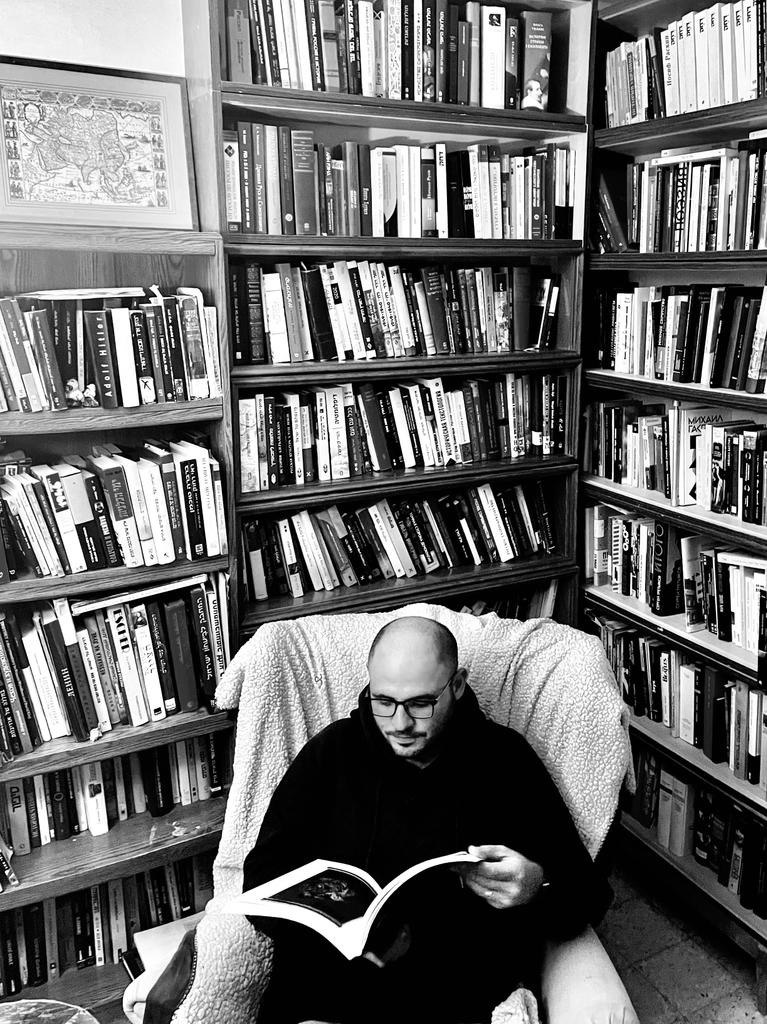
My name is Maaty Frankelson. I am a researcher and archivist with over a decade of experience, as well as a Ph.D. candidate in History. My background includes extensive work in conducting and writing research for academic institutions, foundations, and complex projects. Beyond traditional methodology, I specialize in implementing advanced technologies to optimize archival and historical work.
This is the driving force behind MF Smart Research. I recognized the gap between the vast amount of archival data available and the human capacity to process it. My added value stems from the seamless integration of high-quality academic research with advanced technological capabilities.
Our goal is to propel historical research forward. By utilizing unique technological tools we developed specifically for the historical domain, we assist you in conducting a wide variety of complex historical studies with efficiency and academic quality
The Team at MF Smart Research consists of researchers with multidisciplinary expertise and over a decade of experience in practical archival work, academic research, and public knowledge dissemination. We specialize in conducting diverse historical studies of the highest academic standard, with a specific focus on transforming complex historical knowledge into clear, accessible insights for diverse audiences.
We specialize in conducting diverse historical research at a high academic level, while emphasizing the ability to make complex historical knowledge accessible and clear for diverse populations.
Get in Touch
Government ministries, public authorities, philanthropic foundations, research institutes, and NGOs.
We conduct customized, in-depth studies on specific themes (such as community history, rights restitution, or the analysis of social processes). Our approach bridges the gap between rigorous academic methodology and advanced analytical tools capable of processing vast datasets (Big Data) with maximum speed and precision.
We extract long-term patterns and processes from diverse data sources. This service enables data-driven organizational learning based on verified historical data, providing a solid foundation for contemporary strategy and policy formulation.
We implement secure research environments. This solution allows organization members to "converse" with institutional archives, receive instant answers, and retrieve relevant information from thousands of documents within seconds.
We develop comprehensive roadmaps for complex accessibility projects. We ensure data integrity, adherence to international preservation standards, and high-quality access for both the public and the research community, maintaining the highest academic and archival standards.
Public and private archives, museums, libraries, and heritage conservation centers.
We provide end-to-end solutions that transform raw collections into structured, actionable databases. Our service integrates advanced AI technology with rigorous quality control methodologies, ensuring every data point is accessible, searchable, and verified.
Converting historical document scans into live, searchable text:
Extracting meaning from images and footage, eliminating the need for tedious manual indexing:
Academic researchers (Humanities and Social Sciences), film and TV producers, documentarians, authors, and investigative journalists.
A unique ability to conduct rigorous academic research that simultaneously processes and analyzes large quantities of heterogeneous information sources. Our system can cross-reference, decipher, and synthesize information from manuscripts, official documents, press, and books. This enables researchers to derive qualitative insights from vast amounts of data while maintaining strict academic standards.
Advanced solutions for locating visual materials within image and film repositories. We provide semantic search capabilities within visual content, enabling producers and content editors to find the exact "shot" or the right photograph needed to enrich documentary productions.
Private individuals, genealogists, families interested in documenting their heritage, and communities interested in local history.
Our advanced technologies can read dense handwriting, old postcards, and diaries in various languages, converting them into clear, readable text. We breathe life into documents that have been "silent" for generations, allowing family members to understand the stories hidden within them.
Scanning and cross-referencing information from public archives, immigration lists, historical directories, and legal documents to fill gaps in family trees, locate lost relatives, and map family migration paths.
For those interested in the history of their residence, we provide focused research on specific addresses, land ownership evolution, and historical events that took place in the immediate vicinity, presenting the information in the requested format.
Institutions, organizations, communities, families, and individuals seeking comprehensive documentary projects – from interviews to in-depth historical research.
Conducting structured interviews with period witnesses, veteran institutional figures, and key persons. Documenting personal stories, memories, and testimonies before they are lost forever – via video, audio, or written format.
Mapping and documenting the history of public, educational, health, and other institutions – from their founding to present day. Combining archival sources, interviews, and documents into a complete picture.
Research and documentation of military unit histories, including collecting veterans' testimonies, cross-referencing military and civilian archival sources, and building comprehensive documentation for future generations.
In-depth research of settlement histories – colonies, kibbutzim, villages, neighborhoods, and towns. Reconstructing the stories of settlement, community development, and the events that shaped the place.
Beyond a standard family tree – comprehensive documentary projects including interviews with family members, archival research, collecting photos and documents, and creating a family book or documentary film.
Full management of documentary projects – from defining the research scope, through execution, to producing the final deliverable: a book, research document, presentation, website, or documentary film.
At MF SMART RESEARCH, we utilize developed and tailored unique solutions specifically designed for the challenges faced by researchers, institutions, and archivists.
Systemic analysis of entire archives
Transforming "static" manuscripts into digital text
Deep expertise in historical visual media
AI customized for specific themes
Bridge between past language and research
We have successfully partnered with leading institutions to modernize their archives.
Digitized 500,000+ pages of 19th-century manuscripts with 99% accuracy.
Implemented semantic search across 5 different language collections.
Restored and indexed 50 years of personal correspondence.
Discuss your archival challenges with our research team.
AI-powered historical research combines artificial intelligence technologies such as OCR (Optical Character Recognition), LLM (Large Language Models), RAG (Retrieval Augmented Generation), and autonomous AI research agents to analyze, digitize, and interpret historical documents and archives. This approach dramatically accelerates the research process while uncovering insights that traditional methods might miss.
Our advanced OCR technology is specifically trained to handle the challenges of historical documents, including faded ink, damaged pages, handwritten text, and multiple languages including Hebrew, Arabic, German, and other scripts. We use state-of-the-art machine learning models that continuously improve their accuracy on historical manuscripts, printed books, archival records, and other primary sources.
Our services are designed for a wide range of clients: public and institutional research organizations, archives, museums and preservation institutions, academic researchers, media professionals and documentary creators, as well as individuals pursuing private research, family heritage, genealogy, and local history projects. Whether you're a university researcher, an archivist, or someone tracing your family roots, our AI tools can help.
RAG (Retrieval Augmented Generation) is an AI technique that combines document retrieval with language generation. In historical research, RAG allows researchers to query large collections of digitized documents and receive accurate, source-cited answers. This is particularly powerful for cross-referencing multiple archives, identifying connections between documents, and synthesizing information from diverse historical sources.
Yes, we specialize in end-to-end archive digitization using cutting-edge AI technology. Our process includes high-quality document scanning, OCR text extraction, metadata generation, document classification, and creating searchable digital archives. We work with museums, libraries, government archives, and private collections to preserve and make accessible historical materials.
MF Smart Research uniquely combines deep historical expertise with cutting-edge AI technology. Founded by Maaty Frankelson, a researcher, archivist, and Ph.D. candidate in history, we bring both academic rigor and technological innovation to every project. Our use of AI research agents, combined with traditional research methodologies, ensures comprehensive and accurate results that no purely automated or purely manual approach can match.